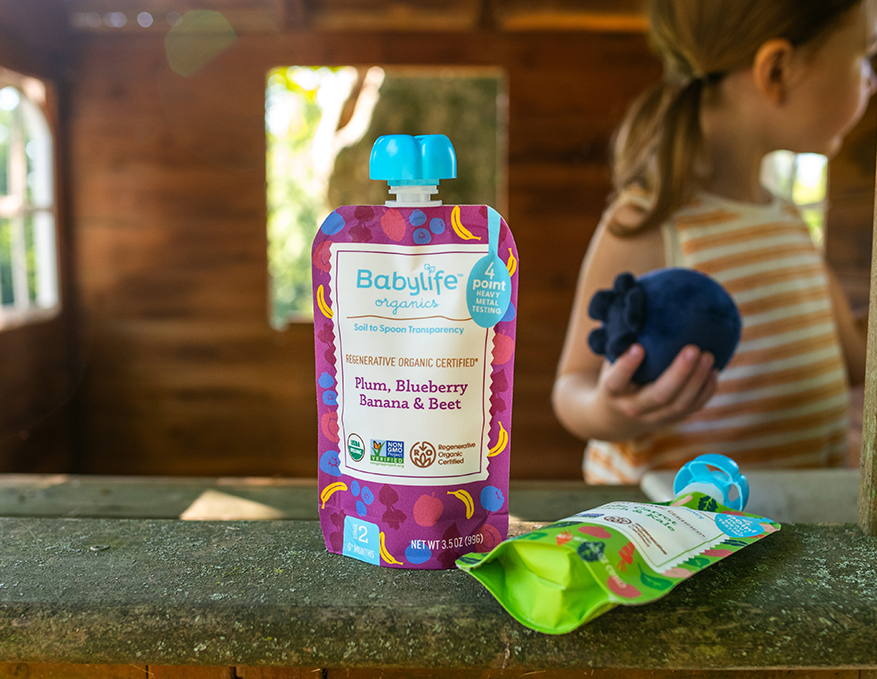

Some parents often assume plastic pouches = risky. We get it. That’s why we didn’t rely on assumptions; we ran the tests.

Microplastics Safety
& Testing Transparency
Because peace of mind should come with proof.


We tested
what matters
Every Babylife Organics Stage 2 pouch flavor variety has been tested for 40+ types of plastics classified as microplastics.
The results? No microplastics detected — no detectable levels of any of the 40+ microplastic types across every pouch flavor variety tested. What does this mean? It means the tests were done, the data was verified by certified third party labs, and the results show non-detection of microplastics in all of our pouch flavor varieties.
Because when it comes to your baby’s food, we’d rather test than guess. Testing for microplastics is just one of our commitments to better baby food.

What We
Tested For
An independent, accredited lab tested for a wide range of known microplastic materials — including those most commonly found in consumer packaging.
How Testing Works
We partnered with accredited, independent labs to perform high-sensitivity analysis that detects even the smallest traces of microplastics.
Each pouch undergoes testing every 90 days because safety isn’t a one-time promise.

Our process includes:
01
Sampling:
Selecting pouch materials and finished products from active production batches.
02
Screening:
Testing for over 40 microplastic types through spectroscopy and particle detection.
03
Analysis:
Reviewing all data for detection thresholds and verification by third-party specialists.
04
Results:
Each Babylife Organics pouch flavor variety has shown non-detectable levels for all tested microplastics.
Why we’re sharing this
Because safety is important and transparency isn’t new for us — it’s who we are.

We already test
4× for heavy metals.

We already grow using
Regenerative Organic Certified® practices.

Front-of-pack communication on 4-point heavy metal testing and on-pack QR code for batch-specific results — something not all brands do.

Radically honest
flavor names.

No concentrates, no
additives, no added water.

No added sugar ever.

Wild-harvested
ingredients.

Microplastics testing is simply another step in our journey of Safety and Transparency — one more way to earn your trust, not just ask for it.


Built for trust.
Raising the standard,
one test at a time.
Babylife Organics is committed to continually raising the standard for baby food safety.
As a leader in intentional sourcing, thorough testing, and transparent practices, we're constantly working to provide the safest baby food to protect what matters most: your baby's health.
Peace of mind should be built in, not hoped for, and your trust is earned by what we do, not what we say.
what this means for you

No detectable microplastics across all tested Stage 2 pouch varieties

Ongoing testing every 90 days

Full transparency — not just promises you have to believe

Safe packaging, verified by data

Looking Ahead
Microplastics safety, confirmed by lab testing, is our goal. Our microplastics testing covers all current Stage 2 pouch flavor varieties, with new products to be added as results become available.
We’ll continue expanding this program and updating this page — because real safety is never “done.”

We test for more than 40 types of plastics classified as microplastics.
This list represents them. We will continue to add tests over time.
- Benzyl butyl phthalate (BBP)
- BHA (Butylated hydroxyanisole)
- BHT (Butylated hydroxytoluene)
- Bis(2-ethoxyethyl) phthalate (DEEP)
- Bis(2-methoxyethyl) phthalate (DMEP)
- Bis(2-n-butoxyethyl) phthalate (DBEP)
- Bis(4-methyl-2-pentyl) phthalate (BMPP)
- Di(2-ethylhexyl) adipate (DEHA)
- Di(ethylhexyl) terephthalate (DEHT)
- Diallyl phthalate (DAP)
- Dibenzyl phthalate (DibenzP)
- Dibutyl adipate (DBA)
- Benzyl butyl phthalate (BBP)
- BHA (Butylated hydroxyanisole)
- BHT (Butylated hydroxytoluene)
- Bis(2-ethoxyethyl) phthalate (DEEP)
- Bis(2-methoxyethyl) phthalate (DMEP)
- Bis(2-n-butoxyethyl) phthalate (DBEP)
- Bis(4-methyl-2-pentyl) phthalate (BMPP)
- Di(2-ethylhexyl) adipate (DEHA)
- Di(ethylhexyl) terephthalate (DEHT)
- Diallyl phthalate (DAP)
- Dibenzyl phthalate (DibenzP)
- Dibutyl adipate (DBA)
- Dibutyl phthalate (DBP)
- Dibutylsebacate (DBS)
- Dicyclohexyl phthalate (DCHP)
- Diethyl adipate (DEA)
- Diethyl sebacate (DES)
- Diethylhexylphthalate (DEHP)
- Diethylphthalate (DEP)
- Diheptyl phthalate (DHP)
- Dihexyl phthalate (DHXP)
- Diisobutyl adipate (DIBA)
- Diisobutylphtalate
- Diisodecyl phthalate (DIDP)
- DiisoHeptylphthalate (DiHP)
- Diisopentyl phthalate (DIPP)
- Diisopropyl phthalate (DiisopropP)
- Dimethyl sebacate (DMS)
- Dimethylphtalate
- DINCH
- Di-n-octylphthalate (DNOP)
- Dinonylphthalate (Sum of DINP and DNNP)
- Dipentylphtalate
- Diphenyl phthalate (DPheP)
- Diundecyl phthalate (DUP)
- TEP (triethyl phosphate)
- tert-Butylhydroquinone (tBHQ)
- Triacetin
- Tributyl phosphate (TBP)
- Tributyl-O-Acetylcitrate (ATBC)
- Triethyl-2-acetylcitrate (ATEC)
- Triisobutyl phosphate (TIBP)
- Triisopropyl phosphate (TIPP)
- Tris(2-chloroisopropyl)phosphate (TCPP)

Research You Can Trust
Our articles dive deep into complex topics like heavy metals and organic standards, translating science into clear, practical guidance for parents.